
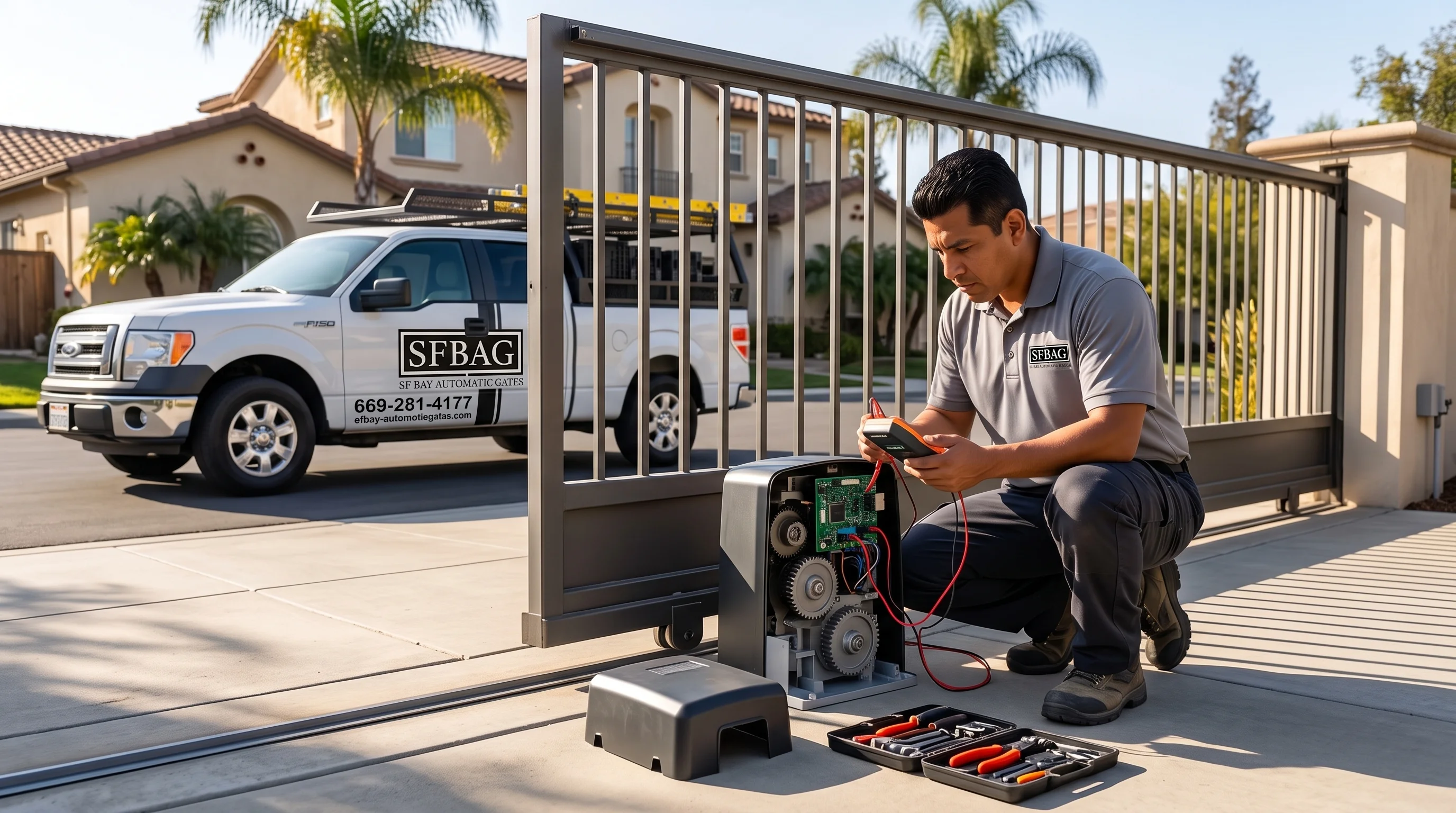
An automated gate should respond almost instantly. Press the remote, enter the code, or pull up to the sensor, and the gate begins to move smoothly and steadily until it is fully open. When that response slows down, stalls, jerks, or requires a second or third attempt, the gate is signaling that something is wrong. Many property owners get used to the delay, but hesitation is rarely a problem that fixes itself. Arranging automatic gate repair while the symptom is still just a hesitation usually prevents the far more disruptive experience of a gate that will not open at all, especially for households and businesses across the Bay Area that depend on their gates every day.
The causes range from simple issues, such as a weak battery or a misaligned sensor, to more serious problems in the motor, gearbox, or control board. The only way to know which applies is a proper diagnosis, and the sooner auto gate repair begins, the more options remain for a straightforward fix.
What Gate Hesitation Usually Means for Auto Gate Repair
Hesitation describes several different behaviors. A gate may pause before starting to move, slow down partway through its travel, stop and reverse, or move in short, uneven bursts. It may work normally in the morning and struggle in the afternoon heat, or operate fine on dry days and falter after rain. Each pattern points toward different causes, which is why technicians handling auto gate repair ask detailed questions about when and how the problem occurs before opening the control box.
In general, hesitation falls into three categories: electrical problems that limit power to the operator, mechanical resistance that makes the gate harder to move, and signal or sensor issues that interrupt the commands the operator receives. Often more than one category is involved, since mechanical strain can overheat electrical components and weak power can make minor mechanical resistance more noticeable. A complete diagnosis looks at the entire system instead of replacing parts one at a time and hoping the symptom disappears.
Electrical and Power Issues
Operators need consistent power to run correctly. Loose or corroded wiring connections, damaged low-voltage cables, tripped breakers, and failing transformers can all reduce the power reaching the motor. Control boards can develop faults from age, heat, moisture, or power surges, causing delayed responses or erratic behavior. These problems may appear intermittently at first, which makes them easy to dismiss until they become constant.
Batteries, Capacitors, and Power Supplies
Many gate operators rely on backup batteries that allow the gate to function during power outages, and in some systems the batteries power daily operation as well. As batteries age, they hold less charge and deliver less power, leading to slow or incomplete movement. Capacitors in AC motors can weaken and prevent the motor from starting smoothly. Solar-powered systems may struggle when panels are dirty, shaded, or undersized for how often the gate is used. Testing and replacing these components is often one of the simplest fixes for hesitation.
How Weather Affects Electrical Components
Cold mornings reduce battery performance, summer heat can cause control boards and motors to overheat, and moisture from rain or fog can corrode terminals and connections. Gates that hesitate more in certain conditions often have components that are already weakened and are simply being pushed past their limits by the weather.
Limit and Force Settings
Every automated gate relies on settings that tell the operator where to stop and how much resistance to tolerate before reversing. Limit settings define the fully open and fully closed positions, while force or sensitivity settings determine how hard the operator will push before deciding that something is in the way. Over time, as hinges wear, posts shift, and seasons change, the effort needed to move the gate changes too, and settings that were correct at installation may no longer fit. A gate whose force setting is too sensitive will stop and reverse at the slightest resistance, which looks like hesitation, while one that is set too aggressively can push through an obstruction and create a safety hazard. Adjusting these settings is part of a proper service visit, but it should always follow mechanical repairs rather than replace them, since turning up the force to overcome a binding hinge only hides the real problem while straining the motor further.
Mechanical Resistance
A gate that does not move freely by hand will strain any operator. Worn hinges, sagging frames, damaged rollers, dirty or bent tracks, and posts that have shifted out of alignment all create resistance. Operators often include safety features that stop or reverse the gate when they detect excessive resistance, which can look like hesitation or random reversals. Correcting the mechanical problem usually restores normal operation and prevents premature motor wear.
Sensors, Remotes, and Access Controls
Photo eyes, safety edges, and loop detectors keep automated gates from closing on people and vehicles, but when they are misaligned, dirty, or damaged, they can send false signals that stop the gate or cause it to reverse. Remotes with weak batteries, receivers with interference, and keypads or intercoms with wiring problems can also delay commands. Checking and recalibrating these devices is an essential part of diagnosing hesitation.
Why Delaying Auto Gate Repair Creates Bigger Risks
Hesitation is often the early stage of a failure. Each struggling cycle adds heat and wear to the motor, gears, and control board, and components that could have been adjusted or replaced individually may eventually fail together. A gate that stops partway can leave a property open and unsecured or trap vehicles inside at inconvenient times. For businesses, a gate failure can disrupt deliveries, employee access, and customer traffic. The longer the problem continues, the more likely it becomes that a simple repair turns into a major one.
Properties with frequent daily use are especially vulnerable. Residential communities, business parks, and homes in East Bay areas like Pleasanton, where gated driveways and neighborhood entries are common, can put hundreds of cycles on a gate each week. Under that workload, a hesitating operator can deteriorate quickly. Responding promptly keeps residents, employees, and visitors moving without interruption and protects the investment in the gate system.
Safety Concerns With Hesitating Gates
Safety is a critical reason not to delay. A gate that moves unpredictably can surprise pedestrians, cyclists, and drivers, and a malfunctioning sensor may fail to detect an obstruction. Children and pets are particularly at risk around gates that do not behave consistently. Ensuring that safety devices function correctly and that the gate stops and reverses as designed is an essential part of any service visit.
What to Expect From Professional Auto Gate Repair
A thorough service visit begins with a conversation about the symptoms and the gate's history, followed by a hands-on inspection. The technician will typically disengage the operator to test how the gate moves manually, check hinges, rollers, tracks, and posts, and then examine the operator, wiring, power supply, batteries, and control board. Sensors, remotes, keypads, and other access devices are tested to confirm they communicate correctly. This comprehensive approach identifies the root cause rather than just the most obvious symptom.
Once the cause is identified, the repair may involve adjusting limits and force settings, replacing batteries or capacitors, repairing wiring, realigning sensors, replacing worn mechanical parts, or repairing the gate frame. A professional should explain what was found, what was fixed, and whether any other components are nearing the end of their service life. Clear communication helps property owners plan ahead and avoid unexpected failures.
Repairing Versus Replacing the Operator
One of the most common questions after a diagnosis is whether the existing operator is worth repairing. In many cases it is. Replacing a capacitor, a battery, a limit switch, or a worn gear set can return an operator to reliable service for years, particularly when the underlying mechanical problems with the gate have also been corrected. Replacement starts to make more sense when the operator is undersized for the gate, when replacement parts are no longer available, when the control board has failed repeatedly, or when the unit lacks the safety features expected of modern systems. Age alone is not the deciding factor, but an older operator that has struggled for a long time against a binding gate has usually absorbed a great deal of wear. A technician should lay out both paths, explain how each affects reliability and safety, and allow the owner to choose based on how the gate is used and how long the property will depend on it.
Keeping Gate Hesitation From Coming Back
Regular maintenance is the best defense against hesitation and breakdowns. Periodic inspections, lubrication of moving parts, battery testing, sensor cleaning, and checks of force and limit settings keep automated gates operating smoothly. Paying attention to changes in speed, sound, or responsiveness allows problems to be addressed before they escalate. For properties throughout San Jose, San Francisco, and the greater Bay Area, a consistent maintenance routine significantly extends the life of gate operators.
A hesitating gate is a warning worth heeding. Addressing the cause promptly keeps the property secure, protects the people who use the gate, and avoids the inconvenience of a sudden failure. When a gate begins to slow down, stall, or respond inconsistently, scheduling professional automatic gate repair is the most reliable way to restore smooth, dependable operation.