
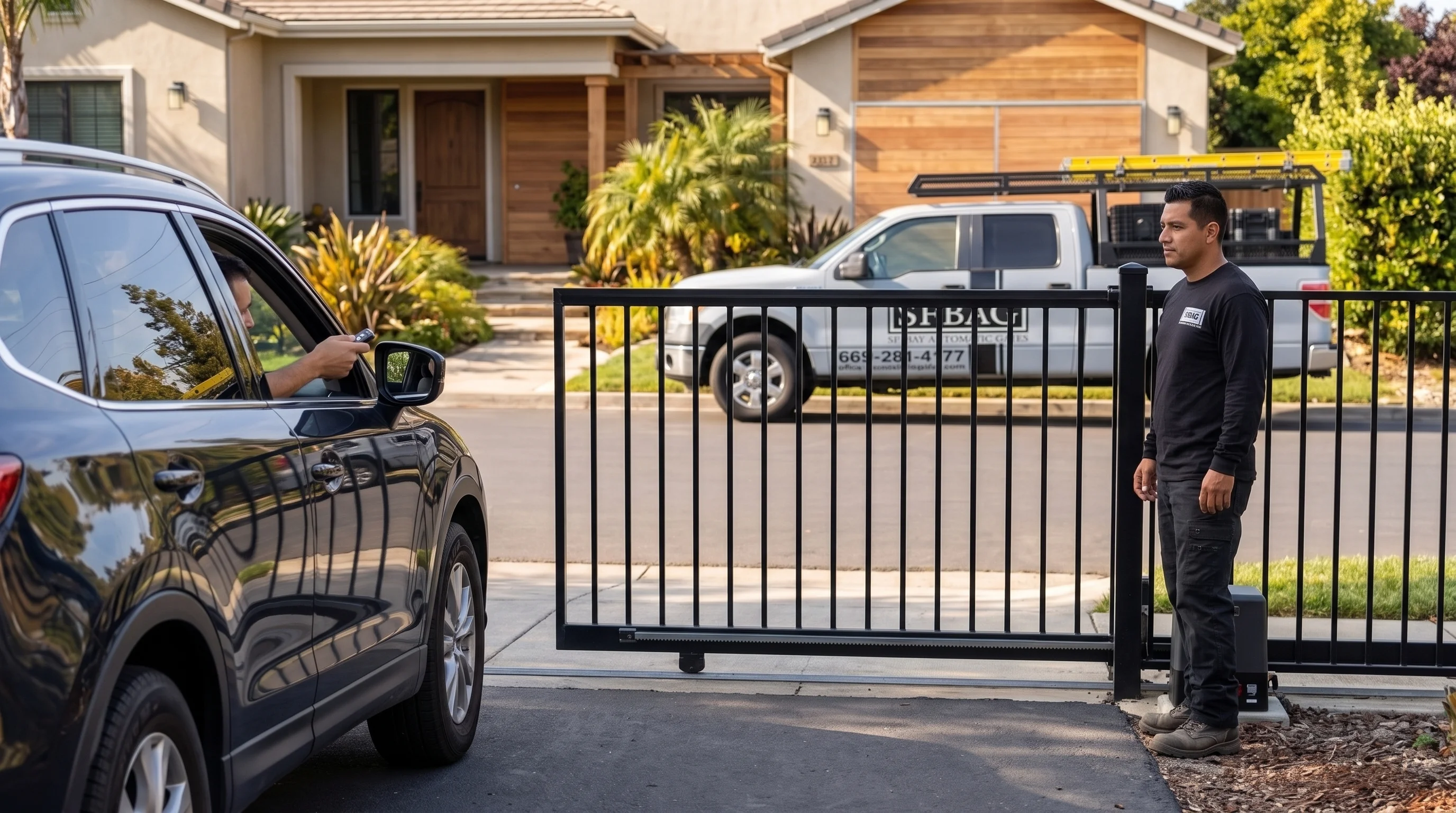
Pulling up to a closed gate, stepping out of the car, opening the gate by hand, driving through, and walking back to close it is a routine many homeowners know all too well. It adds time to every trip, exposes residents to rain and darkness, and often ends with the gate left open because closing it feels like too much effort. A remote-controlled driveway gate removes those steps entirely, allowing the entrance to open as the car approaches and close once it has passed. For households across the Bay Area, the question is not whether remote access is convenient, but whether a remote gate for driveway access delivers enough value for the property and the way the household lives.
The answer depends on how often the gate is used, how the system is designed, and which remote access options fit the household. Understanding those options, along with the practical considerations behind them, makes the decision much clearer and helps avoid a system that looks good on paper but frustrates in daily use.
How a Remote Gate for Driveway Access Works
A remote gate combines an automated operator with one or more ways to send it a command. The operator moves the gate, the control board interprets commands and manages safety devices, and a receiver listens for signals from remotes or other access devices. When a valid signal arrives, the gate opens, and after the vehicle passes, it closes either on command or automatically after a set delay. Safety sensors monitor the opening throughout the cycle and stop or reverse the gate if anything is in its path.
Remote access can take several forms, and many households use more than one. Handheld remotes clipped to a visor or keychain remain the most common, while some vehicles have built-in programmable buttons that can operate gates. Smartphone apps allow the gate to be opened from anywhere with a connection, and vehicle detection loops or sensors can open the gate automatically for departing cars. Keypads and intercoms provide access for visitors who do not have a remote of their own.
Range, Reliability, and Signal Quality
Range determines how early the gate can begin opening as a car approaches. A system with good range allows the gate to be fully open by the time the vehicle reaches it, avoiding waiting in the street. Range can be affected by walls, dense landscaping, metal structures, and the position of the receiver antenna, so placement matters. External antennas mounted with a clear line of sight to the approach often improve performance considerably. Interference from other devices can also affect reliability, which is another reason careful installation is important. Testing range from the actual approach path, at different times of day, confirms that the system responds where drivers really press the button.
Security of Remote Signals
Modern remotes use rolling code technology, which changes the transmitted code with each use so that a captured signal cannot simply be replayed to open the gate. Older fixed-code systems are more vulnerable and are often worth upgrading. Managing remotes also matters. When a remote is lost or a household member moves out, the system should allow that remote to be removed from memory without reprogramming everything else, keeping access current without disrupting the rest of the household.
Smartphone Access and Connectivity
App-based control adds flexibility, letting residents open the gate for a delivery, a family member, or a service provider while away from home. These systems depend on reliable connectivity at the gate, which may require extending the home network with outdoor-rated equipment or using cellular communication. Planning for connectivity during installation prevents frustration later.
Benefits That Go Beyond Convenience
Convenience is the headline benefit, but it is not the only one. A gate that opens and closes without leaving the car is far more likely to stay closed, which improves security and keeps children and pets safely inside. Residents arriving at night or in bad weather remain in their vehicles until they are inside the property, which adds a sense of safety. Older residents and anyone with limited mobility benefit from not having to push a heavy gate, and families with busy schedules save time on every trip in and out.
Remote access also supports better control over who enters. Residents can carry remotes, guests can use temporary codes, and visitors can be screened through an intercom before the gate opens. This combination keeps the entrance convenient for the people who belong there while limiting access for everyone else, and it removes the need to leave the gate open for expected visitors.
Practical Considerations Before Choosing Remote Access
Several factors influence whether a remote gate for driveway access is the right investment. The existing gate must be suitable for automation, meaning it moves freely, hangs square, and is supported by solid posts. Power must be available at the gate, either through electrical service or a properly sized solar system. The layout matters too, since a gate located very close to the street may require faster operation or a different setup so vehicles are not left waiting in traffic while it opens.
Neighborhood context plays a role as well. In Cupertino and surrounding Silicon Valley communities, many homes sit on suburban lots with driveways near busy residential streets, so a responsive system that opens quickly as a car approaches and closes promptly after it passes keeps traffic moving and the entrance secure. Larger hillside properties elsewhere in the region may prioritize range and solar power, while coastal homes need corrosion-resistant hardware and sealed electronics.
Converting an Existing Gate or Starting Fresh
Many manual gates can be converted to remote operation, but the gate must be in good condition first. A gate that sags, drags, or needs to be lifted to latch will strain an operator and wear it out quickly. Hinges may need to be upgraded to heavy-duty styles, posts may need reinforcement, and the frame may need additional bracing to handle repeated automated cycles. When the existing gate is rusted, warped, or too light for automation, replacing it with a gate designed for remote operation from the start often provides better reliability and a longer service life.
Vehicle Detection and Hands-Free Exit
Leaving the property should be just as easy as arriving. Vehicle detection loops cut into the pavement, or sensors mounted near the gate, recognize a departing car and open the gate automatically, so residents do not need to reach for a remote on the way out. Exit detection also prevents anyone from being trapped inside if a remote is misplaced. The loops must be positioned so they detect vehicles reliably without triggering on passing traffic, and they need proper sealing to stay dependable through winter rain.
Sharing Access With Family and Guests
Most households need more than one way in. Family members may each carry a remote, older children may use a keypad code, and regular visitors may receive their own codes that can be changed or deleted at any time. Smartphone apps allow residents to open the gate remotely for a guest who has arrived early, and video intercoms make it easy to confirm who is at the entrance before granting access. Planning these options together ensures everyone can get in easily without weakening security.
Power Outages and Backup Access
A remote gate depends on power, so backup planning is essential. Battery backup allows the gate to continue operating through a number of cycles during an outage, and a manual release provides a fallback for longer interruptions. Residents should know how to use the manual release safely, and the release should be secured so it cannot be accessed from outside the property by someone looking to disengage the operator.
When a Remote Gate Is Most Worth It
A remote gate is most valuable for households that use the entrance several times a day, live on busy streets, have long driveways, or place a high priority on security and privacy. It is also worthwhile for anyone who has stopped closing a manual gate because of the inconvenience. For gates used only occasionally, or properties where bringing power to the gate would be unusually difficult, a simpler solution may make more sense, and an honest evaluation should consider that possibility instead of assuming automation is always the answer.
Making the Decision
The best way to decide is to evaluate the gate, the site, the power supply, and the household's daily routines together. That evaluation reveals whether the existing gate can be automated or should be replaced, which remote access options fit best, and what features such as battery backup, vehicle detection, and intercom screening will add the most value. Across San Jose, San Francisco, and the greater Bay Area, homeowners who take this approach end up with systems that feel effortless from the first day.
Opening the entrance without leaving the car is a small change that has a large effect on daily life, security, and safety. For homeowners ready to make that change, a consultation with specialists in driveway gate design and automation is the clearest way to find out whether a remote-controlled entrance is the right fit.