
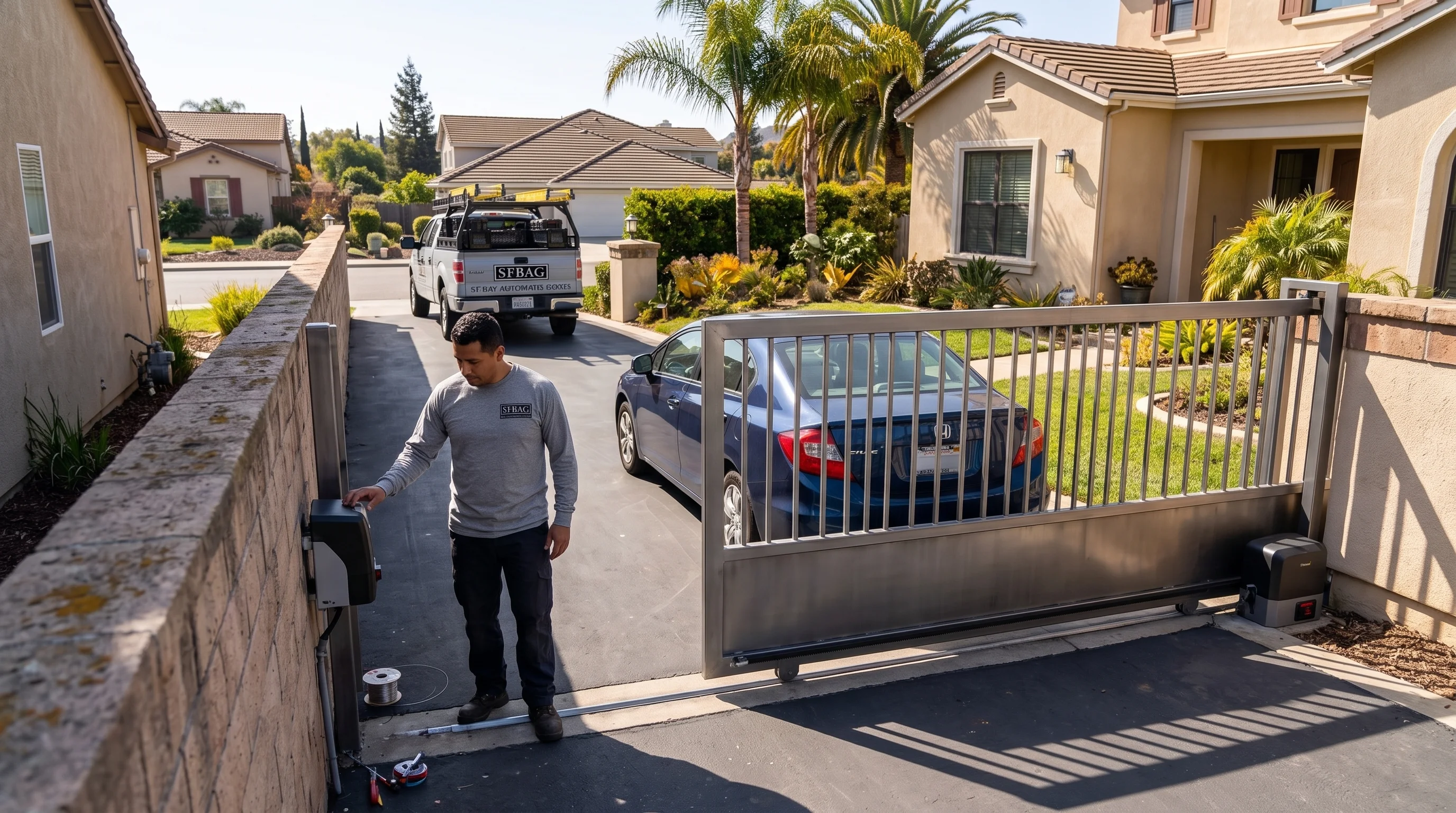
A driveway that curves sharply, sits close to the street, or simply does not offer much room to work with can make gate selection feel more complicated than it needs to be. Many property owners default to a swing-style gate simply because it is the more familiar option, without realizing that the available space on their property may not actually accommodate one well. In situations like this, sliding gates frequently turn out to be the more practical solution, and understanding why starts with looking closely at how each driveway gate style actually uses the space around it.
Why Available Space Should Drive the sliding gates Decision
A swing gate needs enough clearance on the side it opens toward to complete its full arc without striking a parked car, a retaining wall, landscaping, or the slope of the driveway itself. On a flat, wide driveway, this is rarely an issue. On a narrower lot, a steep incline, or a driveway positioned close to the street, that same swing radius can become a genuine obstacle, sometimes forcing a shorter gate than the property actually needs or ruling out a swing design entirely.
How Sliding Design Solves the Clearance Problem
A sliding gate operates along a track that runs parallel to the property line rather than swinging outward or inward, which means it requires clearance to the side rather than in front of or behind the entrance itself. This distinction matters most on properties where the driveway meets the street at an angle, where there is limited setback from the road, or where the terrain slopes in a way that would make a swinging arc unpredictable or unsafe to operate reliably, particularly during wet weather when traction and footing near the gate can become less predictable.
Common Space Constraints That Favor Sliding Over Swing
Several recurring site conditions make sliding gates the more practical choice. A driveway with limited depth between the gate and the street leaves little room for a swing gate to open safely without extending into the roadway. A sloped driveway can cause a swing gate's lower edge to drag or catch on uneven ground. Densely landscaped entrances often lack the open space a swing gate's arc requires without removing established plantings that took years to grow in.
Comparing sliding gates and Swing Gates Beyond Just Space
While space constraints are often the deciding factor, several other considerations come into play once a sliding gate is on the table as a genuine option rather than a fallback choice.
Wind Resistance and Structural Stability
Swing gates, particularly larger or more ornate designs, can catch wind like a sail, placing additional strain on hinges and automation hardware during storms or persistent gusts common across parts of the Bay Area. Sliding gates present less surface area to crosswinds in the direction of travel, which can translate into less mechanical stress on the automation system over time, particularly for taller or more solid gate designs.
Maintenance Differences Between the Two Styles
Sliding gates rely on a track system that requires periodic cleaning to prevent debris buildup from affecting smooth operation, while swing gates depend more heavily on hinge condition and ground clearance remaining consistent over time. Neither style eliminates maintenance entirely, but the specific points of attention differ enough that property owners should factor this into their decision rather than assuming one style is inherently lower maintenance than the other.
What Makes a Property a Strong Candidate for sliding gates
Not every tight driveway automatically calls for a sliding design, and not every wide driveway rules one out. A few specific site characteristics make the case for sliding particularly strong.
Ideal Site Conditions for Sliding Installation
A property with a relatively flat, straight stretch of fence line or wall running alongside the driveway provides the track space a sliding gate needs to operate smoothly. Properties across San Jose and the surrounding Bay Area with this kind of layout, whether along an existing fence or a purpose-built track wall, tend to see the smoothest, most reliable sliding gate performance, since the track has a stable, level surface to follow throughout its full range of motion, and that stability translates directly into fewer alignment issues over the long run.
When Swing Gates Still Make More Sense
Sliding gates are not universally superior; they simply solve a specific set of space constraints. Properties with ample clearance in front of the entrance and no adjacent track space available may find that a swing gate remains the simpler, more cost-effective option, particularly when the driveway's layout does not naturally accommodate a long, straight run for a sliding track.
Automation Considerations for sliding gates
Automated sliding gates typically use a motor connected to a drive mechanism that moves the gate along its track, and the specific hardware involved differs somewhat from what a swing gate automation system requires.
Motor Placement and Track Alignment
Because a sliding gate's motor engages with the gate along a horizontal track rather than at a pivot point, precise track alignment during installation directly affects how smoothly the automation performs over time. A track installed slightly out of level or improperly anchored tends to create uneven strain on the motor, which can shorten its functional lifespan and lead to more frequent driveway gate repair needs than a properly aligned system would require.
Safety Sensor Placement Along the Track
Sliding gates typically incorporate sensors along the track's path to detect obstructions before the gate makes contact, and correct placement of these sensors is particularly important given how a sliding gate's motion differs from a swing gate's arc. Technicians familiar with sliding systems position these sensors to account for the gate's full range of travel, reducing the chance of a blind spot where an obstruction could go undetected.
Aesthetic and Design Flexibility With Sliding Gates
A common misconception is that sliding gates offer fewer design options than swing gates, but modern sliding systems accommodate a wide range of materials, finishes, and decorative elements just as swing gates do. Ornamental metalwork, solid privacy panels, and combination designs mixing open and solid sections are all achievable with a sliding configuration, meaning the choice between sliding and swing rarely has to come at the expense of the property's overall aesthetic.
Matching Sliding Gate Style to Property Character
Properties across San Francisco and the surrounding Bay Area with a wide range of architectural styles, from modern minimalist homes to more traditional properties, can typically find a sliding gate design that complements the existing structure rather than looking like a purely functional add-on. Working with a designer or contractor familiar with sliding systems helps ensure the finished gate integrates visually with the property rather than simply solving the space problem at the cost of curb appeal.
Cantilever Versus Track-Mounted Sliding Systems
Traditional sliding gates run along a track embedded in the ground, which works well for most properties but can be affected by debris or, in rare cases, ground movement over time. Cantilever sliding gates, which support the gate's weight entirely above ground using an internal counterbalance system, avoid this issue entirely and have become an increasingly popular option for properties that want the benefits of a sliding design without a ground-level track to maintain. This added flexibility means property owners are rarely forced into a single sliding configuration, and can instead choose the specific approach that best matches their site conditions and long-term maintenance preferences.
Making the Right Choice for a Constrained Driveway
Property owners dealing with a tight driveway, an angled entrance, or limited clearance around the gate area are often better served by a sliding design than by trying to make a swing gate fit a space it was never well suited for in the first place. Evaluating available clearance honestly, rather than defaulting to the more familiar swing style, tends to produce a gate that operates smoothly for years rather than one that strains against the limitations of its site from day one.
Property owners across the Bay Area weighing their options for a constrained entrance are well served by having a professional evaluate the specific site conditions before committing to a style, since the right driveway gate design depends as much on available space as it does on personal preference, and getting that assessment right from the start tends to save considerable frustration down the line.
A driveway that seemed too tight or awkward for an automated gate at first glance often turns out to have a perfectly workable solution once sliding is considered alongside the more familiar swing option, and that broader perspective is usually what leads to a gate that fits the property well for years to come, without the compromises that come from forcing a design onto a site it was never quite suited for.