
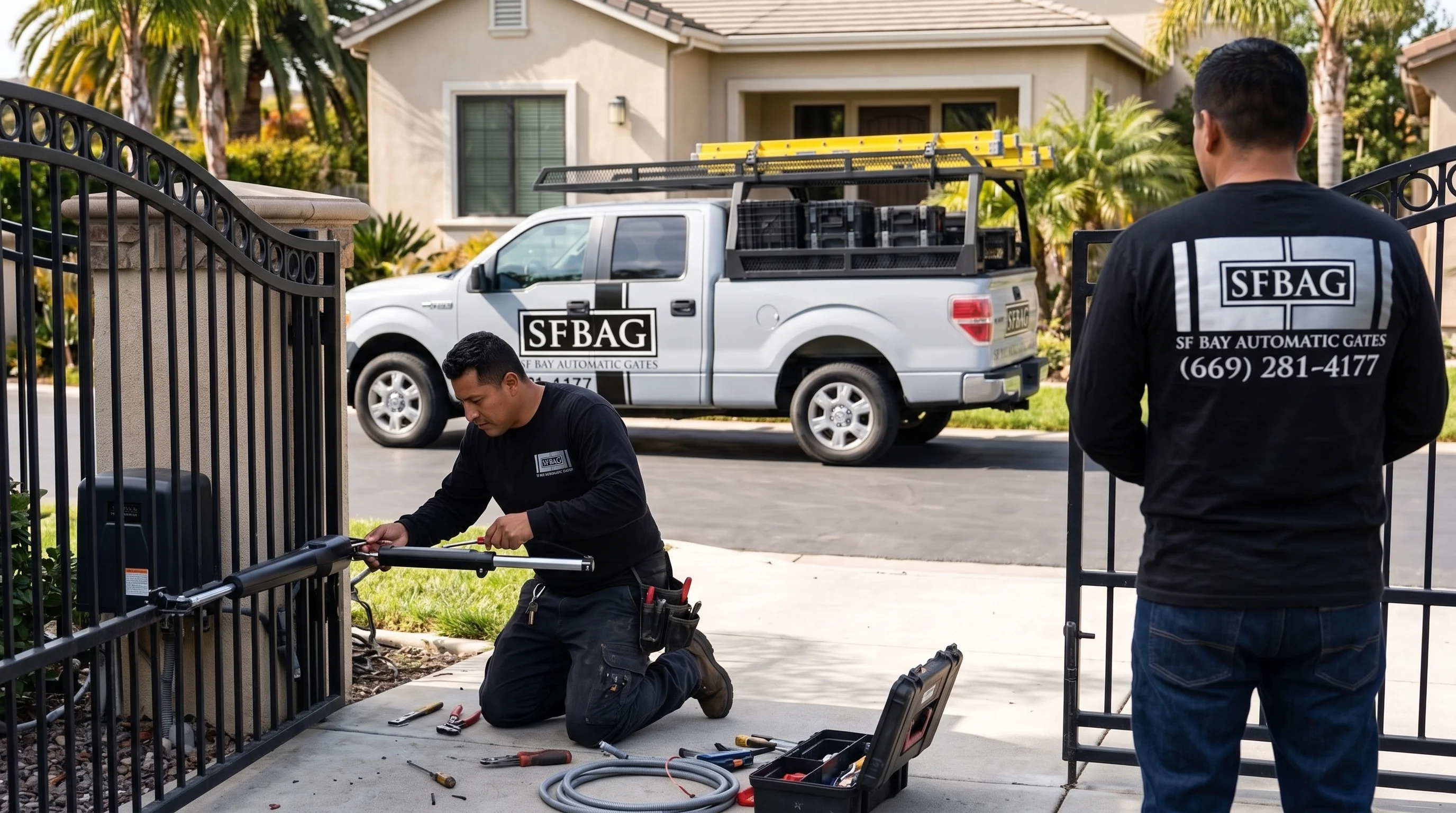
Opening a driveway gate by hand seems like a small task until it becomes part of every arrival and departure. Stopping the car, stepping out in the rain or the dark, swinging the gate open, pulling through, and getting out again to close it adds minutes to every trip and creates moments when the property sits open and unattended. Many homeowners eventually stop closing the gate at all, which defeats the reason it was installed in the first place. Across the Bay Area, more property owners are turning to automatic gate installation to solve that problem, either by converting an existing manual gate or by replacing it with a system designed for automation from the start.
Automated gate installation changes more than convenience. It affects security, safety, privacy, and how a property is used day to day. Understanding what the upgrade involves, and whether an existing gate is a good candidate for conversion, helps homeowners decide whether the investment makes sense for their situation and their household's routines.
What Automated Gate Installation Changes Day to Day
The most obvious benefit is convenience. A remote, keypad, or smartphone opens the gate as a vehicle approaches, and the gate closes automatically once the car is through. Residents no longer need to leave the car in bad weather, juggle groceries while unlatching a gate, or decide whether to leave the entrance open for a quick errand. For older residents and anyone with limited mobility, removing the need to push a heavy gate can make a real difference in daily independence and comfort.
Security improves because the gate actually stays closed. A manual gate that is left open half the time provides little protection, while an automated gate closes behind every vehicle and can be set to close after a short delay if someone forgets. Access can be granted to guests, house cleaners, landscapers, or delivery drivers through temporary codes or remote approval through a video intercom, without handing out keys. Activity logs on some systems also show when the gate was used and by whom.
Safety Benefits for Families and Pets
An open gate is an easy path to the street for children and pets. Automated systems keep the entrance closed by default and allow it to open only when someone deliberately triggers it. Modern safety devices stop and reverse the gate if anything is in its path, and properly adjusted force settings prevent it from pushing against an obstruction. For families on busy streets, this combination of a closed perimeter and controlled movement is often the deciding factor in choosing to automate.
Can an Existing Manual Gate Be Automated?
Many manual gates can be converted, but not all of them should be. An operator adds repeated starting and stopping forces that a hand-operated gate never experiences, and those forces expose any weakness in the frame, hinges, posts, or footings. Before automation, the gate should swing or slide freely by hand, hang square without sagging, and clear the driveway through its entire travel. If it drags, binds, or needs to be lifted to latch, those problems must be corrected first, or the operator will struggle and wear out prematurely.
Evaluating Weight, Hinges, and Posts
The weight and width of the gate determine which operators can move it safely. Heavy wood or solid steel panels may require a more powerful operator than an open picket design of the same size, and wind exposure adds load that must be considered. Light-duty hinges often need to be replaced with heavy-duty bearing hinges, and posts that were set shallowly for a manual gate may need to be reinforced or replaced. These upgrades are part of a proper conversion and help the system operate smoothly for many years.
Swing Gate and Sliding Gate Operators
Swing gates are typically automated with articulated arm operators mounted on the posts, linear actuators attached between the post and the gate, or underground operators hidden beneath the hinges for a cleaner appearance. Sliding gates use operators that drive the gate along a gear rack or chain, either on a ground track or on a cantilever system that carries the gate without touching the driveway. Each type has strengths, and the best choice depends on the gate's design, the available space, and the look the homeowner prefers for the entrance.
When Replacement Makes More Sense
Some gates are not worth converting. A frame weakened by rust, a wood gate that has warped, or a design that is simply too light to withstand repeated automated cycles may require more reinforcement than a replacement would. In those cases, a new gate built for automation from the start often delivers better reliability and a longer service life, along with the chance to update the style of the entrance to suit the home.
Power Options and Access Control Choices
Automated gates need a dependable power source. Hardwired electrical service is the most common option and supports higher-cycle use, while solar power can be practical for gates far from the house or where trenching would disturb mature landscaping or paving. Battery backup is strongly recommended in either case so the gate keeps working during outages, and every operator should include a manual release for situations when power is unavailable for an extended period.
Access control determines how the system fits into daily life. Handheld remotes remain popular for residents, keypads allow code-based entry for guests and service providers, and video intercoms let homeowners see and speak with visitors before opening the gate. Smartphone access and integration with home automation systems add flexibility, allowing the gate to be opened remotely for a delivery or a family member who forgot a remote. Vehicle detection allows the gate to open automatically for departing cars, which keeps traffic moving and prevents anyone from feeling trapped inside.
Planning Around Neighborhood Conditions
Local conditions influence how a system should be designed. In Mountain View and other Silicon Valley communities, many homes sit on compact lots with driveways close to the sidewalk, which can favor sliding gates or operators with minimal space requirements, along with careful sensor placement for pedestrians passing by. Hillside homes elsewhere in the region may need more powerful operators and special hinges for sloped driveways, while coastal properties benefit from corrosion-resistant hardware and sealed control boxes. A design that reflects these realities performs far better than a generic installation.
Is Automated Gate Installation Worth the Investment?
The value of automation depends on how often the gate is used, how important security and privacy are to the household, and whether the existing gate is a good candidate for conversion. For homes where the gate is opened several times a day, the time saved and the improved security often justify the upgrade quickly. Automated entrances are also seen by many buyers as a desirable feature, particularly in neighborhoods where privacy and controlled access are valued. The investment is most worthwhile when the system is designed and installed correctly, since a poorly matched operator or an unprepared gate can lead to repeated repairs.
A thorough evaluation should look at the gate, posts, power availability, site conditions, and how the household plans to use the system. That evaluation clarifies whether conversion is practical, which operator and access options fit best, and what preparation is needed before installation begins. Homeowners who start with this kind of assessment avoid surprises and end up with a system that feels effortless from the first day of use.
Living With an Automated Gate
Once the system is in place, a few habits keep it working smoothly. Residents should know where the manual release is, how to operate it safely, and how to secure the gate if it must be left disengaged during an outage. Batteries in remotes and backup systems need periodic replacement, and safety sensors should be kept clear of leaves, spider webs, and overgrown plants that can trigger false reversals. Watching for changes in sound, speed, or alignment helps catch developing problems early, before a minor adjustment turns into a repair that leaves the entrance out of service.
Scheduled maintenance adds another layer of reliability. A technician can lubricate hinges or rollers, check operator mounting and gear wear, test safety devices, confirm force and limit settings, and inspect wiring and control boards for moisture or corrosion. Many households pair this service with seasonal changes, checking the system before the rainy season and again before the summer heat. That routine keeps the convenience of automation from turning into a source of frustration and protects the investment for years.
Getting the Upgrade Right From the Start
The difference between an automated gate that works flawlessly and one that causes frustration usually comes down to installation quality. Proper alignment, correctly sized operators, secure mounting, careful wiring, and thoroughly tested safety devices all matter. A qualified installer should explain each choice, provide clear instructions for daily use and manual release, and offer maintenance to keep the system reliable. Across San Jose, San Francisco, and the wider Bay Area, homeowners who invest in a careful installation enjoy years of convenient, secure access.
Manually opening a gate may seem like a minor inconvenience, but the cumulative effect on security, safety, and daily routines is significant. For homeowners ready to leave that routine behind, a consultation with specialists in automatic gate installation is the best way to find out whether converting the current gate or starting fresh will deliver the most dependable result.