
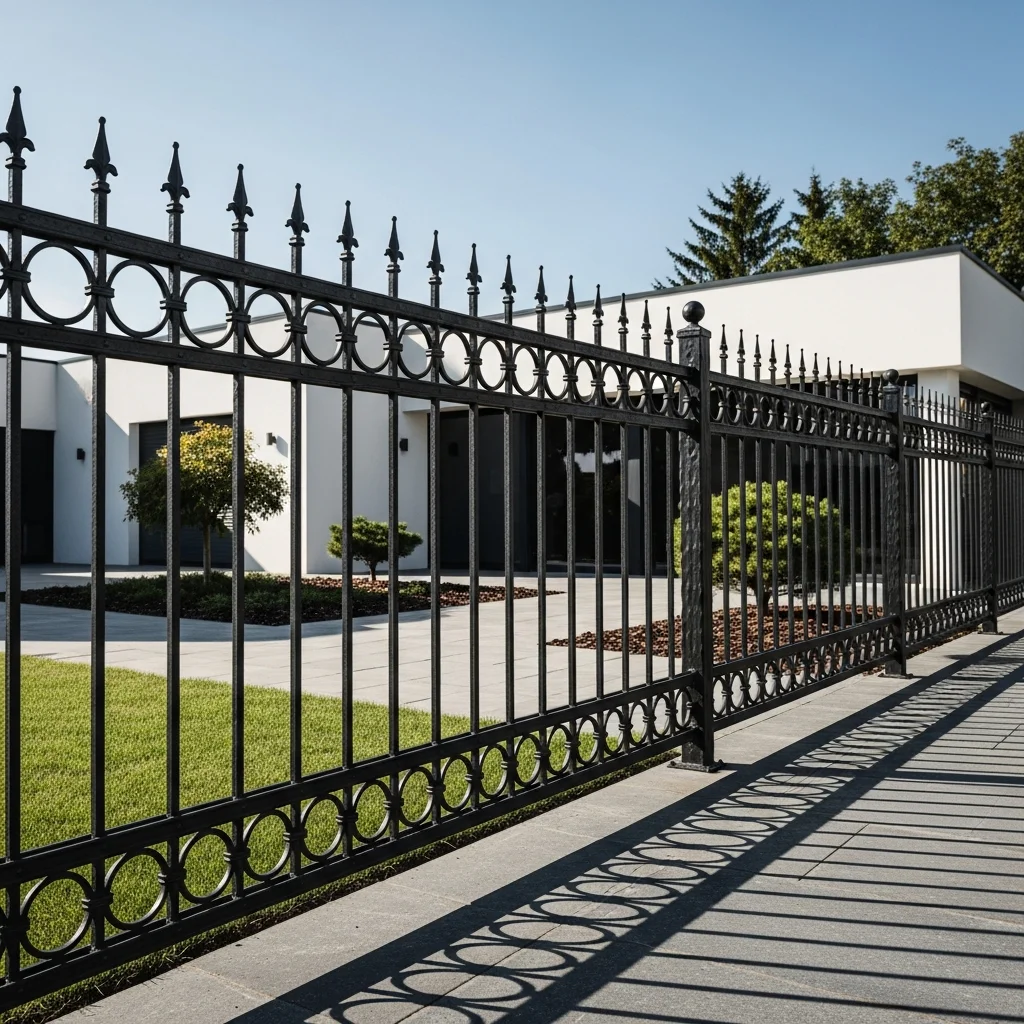
Wrought iron fences, esteemed for their durability and aesthetic versatility, offer an array of classic designs suitable for enhancing various architectural styles. Key among these are the Victorian, Colonial, and Gothic patterns, each distinguished by unique decorative elements such as scrollwork, symmetrical lines, and pointed arches, respectively. Proper installation is vital to maintaining the structural integrity and visual appeal of these fences. It involves precise steps starting from site preparation to the final assembly of rails and panels. Understanding these foundational aspects not only guarantees robust installation but also preserves the timeless elegance wrought iron fences are known for. This comprehensive exploration covers protective coatings and maintenance practices essential for prolonging the life of these metal barriers.
SF Bay Automatic Gates recognizes that wrought iron fencing represents one of the most enduring and elegant perimeter solutions available to property owners. The combination of strength, beauty, and longevity that wrought iron provides makes it a preferred choice for discerning homeowners and commercial property managers seeking to enhance security while maintaining sophisticated aesthetics. This guide explores the rich tradition of wrought iron fence design while providing practical installation guidance for those considering these classic structures.
Understanding Wrought Iron as a Fencing Material
Before examining specific styles and installation techniques, understanding what distinguishes wrought iron from other metal fencing materials provides important context for appreciating its unique characteristics and proper application.
Material Composition and Properties
True wrought iron contains very low carbon content, typically less than 0.08%, with iron silicate slag inclusions creating its characteristic fibrous structure. This composition yields material that is inherently corrosion-resistant, malleable when heated, and remarkably durable under stress. The slag fibers running through wrought iron give it a grain structure similar to wood, making it resistant to cracking and fatigue failure that affects higher-carbon steels.
The malleability of wrought iron enables the intricate decorative work that defines classic fence styles. Skilled metal fence contractors can forge, twist, and form wrought iron into complex scrollwork, rosettes, and custom ornamental elements impossible with harder, more brittle materials. This workability during fabrication translates to aesthetic possibilities that set wrought iron apart from aluminum or steel alternatives.
Modern "wrought iron" fences often utilize mild steel rather than true wrought iron due to cost and availability factors. While these steel alternatives lack some traditional wrought iron characteristics, quality fabrication using appropriate steel grades and protective treatments creates fences that capture the aesthetic appeal and functional performance associated with historical wrought iron installations.
Historical Significance and Architectural Context
Wrought iron fencing traces its prominence to the 17th and 18th centuries when advances in iron production made the material accessible for architectural applications beyond purely industrial uses. European estates, particularly in France and England, featured elaborate wrought iron gates and fencing that demonstrated wealth, taste, and craftsmanship. These historical installations established design vocabularies that continue influencing contemporary fence styles.
American adoption of wrought iron fencing accelerated during the 19th century as foundries expanded production capacity and architectural movements embraced ornamental metalwork. Cities like New Orleans, Charleston, and Philadelphia developed distinctive regional wrought iron styles reflecting local architectural preferences and cultural influences. These regional variations contribute to the rich diversity found in classic wrought iron fence designs.
Understanding this historical context helps property owners select fence styles harmonizing with their architecture and neighborhood character. A residential fence contractor knowledgeable about architectural history can guide style selection ensuring compatibility with property context rather than jarring stylistic conflicts.
Classic Styles of Wrought Iron Fences
Wrought iron fences are renowned for their durability and aesthetic appeal, often serving as demonstrations of craftsmanship and design throughout history. These timeless structures not only secure properties but also enhance their visual harmony, integrating seamlessly into various architectural styles.
Victorian Style Wrought Iron Fences
Among classic styles, the Victorian motif is prominent, characterized by intricate scrollwork and floral elements, symbolizing elegance and refined taste. This style often features spear-topped pickets for added security while maintaining an open, inviting appearance. Victorian wrought iron fences reached peak popularity during the mid-to-late 19th century, adorning properties from modest townhomes to grand estates.
The defining characteristics of Victorian fence design include:
Ornamental Complexity: Elaborate scrolls, C-curves, and S-curves create flowing patterns throughout fence panels. These decorative elements often incorporate naturalistic motifs, leaves, vines, flowers, rendered in stylized forms. The ornamentation typically concentrates at panel centers and top rails while vertical pickets maintain simpler profiles.
Spear and Finial Treatments: Picket tops feature decorative treatments ranging from simple spear points to elaborate finials incorporating balls, urns, or fleur-de-lis elements. These vertical accents add visual interest while serving the practical purpose of discouraging climbing. Fence installation companies specializing in Victorian styles maintain libraries of traditional finial patterns enabling authentic reproductions.
Layered Depth: Victorian designs often incorporate multiple planes creating dimensional depth. Foreground elements like scrollwork overlay background pickets, with spacing creating shadow patterns that enhance visual richness. This layering requires precise fabrication ensuring components align properly during assembly.
Gate Emphasis: Entry gates in Victorian installations typically feature heightened ornamentation compared to fence runs, establishing clear hierarchies and marking transitions between public and private spaces. Gate designs might incorporate arches, prominent scrollwork, or custom monograms identifying properties.
Victorian wrought iron fences suit properties with corresponding architectural styles, Queen Anne, Second Empire, Italianate, or Victorian Gothic buildings. The style also complements formal gardens and traditional landscape designs where ornamental fencing enhances overall aesthetic cohesion.
Colonial Style Wrought Iron Fences
Another traditional design is the Colonial style, which focuses on symmetry and simplicity, mirroring the architectural lines of Colonial American homes. These fences typically display less ornate, more functional designs such as evenly spaced vertical bars with basic geometric patterns at intervals, promoting a sense of order and community.
Colonial fence characteristics include:
Geometric Clarity: Rather than flowing organic curves, Colonial designs emphasize straight lines, right angles, and simple geometric shapes, circles, squares, diamonds. This clarity reflects Enlightenment-era values of reason and order that influenced Colonial architecture. The restraint creates sophisticated elegance through proportion and balance rather than decorative elaboration.
Symmetrical Composition: Panel designs display perfect bilateral symmetry with decorative elements mirrored across central axes. This symmetry extends to overall fence composition with gate placements, panel divisions, and ornamental features following balanced arrangements. The visual harmony reinforces Classical architectural principles.
Restrained Ornamentation: While not entirely plain, Colonial wrought iron uses ornamentation judiciously. Simple scrolls might appear at regular intervals, twisted or ringed picket sections provide textural variation, and modest finials top posts. The decoration enhances without overwhelming, maintaining emphasis on structural clarity.
Proportion and Scale: Colonial designs observe Classical proportion systems where element relationships follow mathematical ratios creating inherent visual harmony. Picket spacing, rail heights, and panel dimensions relate through these proportional systems rather than arbitrary measurements.
Colonial wrought iron fences harmonize with Federal, Georgian, Colonial Revival, and neoclassical architecture. The style suits both residential and commercial fence contractor applications where traditional formality aligns with institutional or professional images. Properties in historic districts often find Colonial styles meet preservation guidelines while providing security and definition.
Gothic Style Wrought Iron Fences
The Gothic style, with its pointed arches and bold, linear patterns, reflects a more dramatic aesthetic. Often seen in historical districts and older properties, these designs convey a sense of heritage and continuity, fostering deep connections among community members who value preservation and tradition.
Gothic wrought iron fence characteristics:
Pointed Arch Motifs: The defining Gothic element, the pointed arch, appears throughout fence designs in various scales and applications. Large arches might span gates while smaller arch forms repeat in panel designs. These vertical arches create upward movement and spiritual associations characteristic of Gothic architecture.
Tracery Patterns: Inspired by Gothic window tracery, these intricate geometric patterns fill panels with interlocking shapes, quatrefoils, trefoils, and other cusped forms. The complexity rivals Victorian ornamentation but maintains Gothic geometric character rather than naturalistic flowing curves.
Vertical Emphasis: Gothic designs strongly emphasize vertical lines through tall, slender pickets, clustered vertical elements, and upward-pointing finials. This verticality creates feelings of height and aspiration associated with Gothic cathedrals, though at more modest fence scales.
Dramatic Finials: Picket tops feature pronounced pointed finials, sometimes with multiple points or elaborate Gothic-inspired forms. These dramatic terminals reinforce vertical emphasis while providing functional deterrence against climbing.
Gothic wrought iron suits properties with corresponding architectural styles, Gothic Revival, Tudor Revival, or Victorian Gothic buildings. The style also works well for churches, cemeteries, academic institutions, and properties where historical gravitas aligns with functional purposes. A local fence installer experienced with Gothic patterns can execute the geometric precision these designs require.
Mediterranean and Spanish Colonial Styles
In regions with Mediterranean or Spanish Colonial architectural influences, wrought iron fence styles reflect these cultural traditions through distinct design vocabularies.
Simplified Baroque Elements: Mediterranean styles often incorporate simplified versions of Baroque scrollwork, looser, more casual curves than formal Victorian patterns. These flowing elements suggest Old World craftsmanship without excessive ornamentation.
Twisted and Hammered Details: Hand-forged appearance through twisted pickets, hammered textures, and irregular spacing creates rustic, artisanal character. Even when fabricated through modern manufacturing, these elements convey traditional craftsmanship associations.
Earth
- Toned Finishes: Rather than glossy black, Mediterranean wrought iron often features matte finishes in browns, dark greens, or textured black suggesting aged iron. These finishes harmonize with stucco, tile, and stone materials common in Mediterranean architecture.
Integration with Masonry: Mediterranean designs frequently combine wrought iron with stucco-covered walls, stone columns, or brick elements. The iron sections might fill openings between masonry piers or cap low walls, creating hybrid fencing solutions.
These regional styles suit Spanish Colonial Revival, Mission Revival, Mediterranean Revival, and Hacienda-style properties. Commercial fence contractor applications include resorts, restaurants, and commercial properties cultivating Mediterranean ambiance.
Contemporary Wrought Iron Interpretations
Modern metal fence contractors also create contemporary interpretations of wrought iron fencing that honor traditional material qualities while embracing minimalist aesthetics.
Geometric Modernism: Clean geometric patterns using squares, rectangles, and linear elements create modern visual languages. The traditional wrought iron strength and durability serve contemporary design sensibilities.
Simplified Forms: Reduction to essential elements, perhaps just simple pickets and rails without ornamentation, creates understated elegance. The inherent quality of materials and craftsmanship receives emphasis rather than applied decoration.
Custom Artistic Elements: Contemporary designs might incorporate custom artistic elements, abstract sculptures, laser-cut patterns, or architectural metalwork, integrated within traditional fence structures. These hybrid approaches bridge historical materials and contemporary expression.
Contemporary wrought iron suits modern architecture, minimalist landscapes, and properties where traditional ornamental styles would clash with architectural character. The approach demonstrates wrought iron's continuing relevance beyond historical reproduction.
Step-by-Step Installation Guide
Setting up a wrought iron fence involves a series of precise steps to secure both aesthetic charm and structural strength. Proper installation ensures longevity, performance, and appearance that justifies investment in quality wrought iron fencing.
Site Preparation and Planning
Start by marking the perimeter where the fence will be assembled, using stakes and string for precise alignment. It's vital to verify property lines to prevent any potential disputes or encroachments. Professional fence installation companies conduct surveys or consult existing property documentation establishing exact boundaries before beginning work.
Utility location represents a critical preliminary step. Contact local utility notification services (811 in the United States) to mark underground utilities, gas, electric, water, telecommunications, before any digging. Striking utilities creates serious safety hazards, service disruptions, and potential liability. Most jurisdictions require utility location before excavation work.
Site grading evaluation identifies slopes, drainage patterns, and ground conditions affecting installation. Significant slopes might require stepped panels or custom grading to maintain consistent fence heights and post plumb. Poor drainage near fence lines could undermine post foundations, necessitating drainage improvements before fence installation.
Accessibility assessment determines equipment access for post hole digging, material delivery, and installation work. Restricted access might require hand-digging post holes or material staging in multiple locations. These logistics affect installation timing and costs.
Post Hole Excavation and Preparation
Next, dig post holes roughly 2 feet deep and 6 inches in diameter, making sure they are spaced according to fence design specifications. This spacing is fundamental as it influences stability and appearance of final structures. For optimal results, consider consulting licensed fence contractors to ensure installation is handled with expertise and meets local regulations.
Standard wrought iron fence post spacing ranges from 6 to 8 feet on-center depending on panel sizes, terrain, and design requirements. Closer spacing increases material costs but provides greater strength and allows shorter panel spans. Wider spacing reduces costs but may require heavier posts and rails supporting longer spans.
Post hole depth should reach below frost lines in cold climates to prevent frost heave, ground movement from freeze-thaw cycles that can shift posts over time. Frost depths vary by region from 12 inches in mild climates to 48 inches or deeper in northern areas. Local building codes specify required depths based on regional conditions.
Post hole diameter affects concrete volume and lateral support. Wider holes accommodate more concrete, increasing resistance to lateral forces from wind loading or impact. Six-inch diameter represents minimum for typical residential applications, while heavier commercial installations might require 8 to 12-inch diameters.
Excavated soil should be evaluated for bearing capacity and drainage characteristics. Sandy or gravelly soils typically drain well and provide good bearing. Clay soils may retain water and expand when wet, creating pressure on post foundations. Extremely poor soils might require larger holes, deeper footings, or concrete augmentation with rebar or gravel bases.
Post Setting and Alignment
After holes are prepared, insert fence posts. Use a level to guarantee each post stands perfectly vertical for consistency. Plumb posts ensure gates hang properly, panels align correctly, and finished fences maintain professional appearances. Two-person installation teams can check plumb in both directions while one person holds posts and another verifies alignment.
Temporary bracing stabilizes posts during concrete setting. Cross-bracing using wooden stakes and horizontal boards prevents post movement while concrete cures. These temporary supports remain in place for 24 to 48 hours until concrete achieves sufficient strength.
String lines stretched between corner or end posts establish height alignment for intermediate posts. Setting end posts first at exact heights, then running string between them creates reference lines for positioning all intermediate posts at consistent heights. This technique ensures fence top rails follow true horizontal lines rather than undulating profiles.
Mix concrete following manufacturer's guidelines and pour it around the base of each post, filling up to a few inches below ground level. Allow concrete to set as advised before proceeding with installation of fence panels. Concrete mixture ratios affect strength and curing characteristics, typically 1 part cement, 2 parts sand, 3 parts gravel for fence applications.
Concrete should be worked thoroughly around posts eliminating air pockets that would weaken foundations. Vibrating or tamping concrete during placement ensures complete fill and good contact with post surfaces. Slight crowning, mounding concrete slightly above grade sloping away from posts, encourages water drainage away from post bases.
Curing time varies with temperature and concrete formulation. Warm temperatures accelerate curing while cold weather slows the process. Full strength typically develops over 28 days, though sufficient strength for continued installation usually develops within 24 to 72 hours. Fence repair services addressing failed posts often find inadequate curing contributed to premature failures.
Panel and Rail Installation
Attach panels to posts using brackets and screws tailored for wrought iron. This connection must be firm to withstand weather and physical stress. Panel mounting methods vary depending on fence design and manufacturer specifications.
Bracket Mounting: Pre-fabricated panels often include mounting brackets welded to panel frames. These brackets bolt to posts through pre-drilled holes, creating strong mechanical connections. Brackets should be hot-dip galvanized or stainless steel preventing corrosion at connection points where moisture can accumulate.
Rail and Picket Assembly: Some installations assemble fences from separate rails and pickets rather than pre-fabricated panels. Rails attach to posts first, then pickets insert into rail mortises or mount to rail surfaces. This component-based approach allows field adjustment accommodating terrain variations or custom spacing.
Welded Connections: Permanent installations sometimes weld panels directly to posts creating seamless, extremely strong connections. Welding requires skilled metal fence contractors and produces connections stronger than mechanical fasteners. However, welded fences are essentially permanent, complicating future modifications or repairs.
Alignment during panel installation affects finished appearance significantly. Panels should align horizontally, top rails following consistent heights, and vertically, pickets standing plumb rather than leaning. Careful measurement and adjustment during mounting prevents crooked appearances requiring difficult correction.
Gates require special attention during installation. Gate posts experience greater stress from opening/closing cycles and hardware weight. These posts often require larger dimensions, deeper footings, or reinforcement compared to line posts. Gate hardware, hinges and latches, must be precisely positioned ensuring smooth operation and proper alignment when closed.
Protective Coating Application
Wrought iron's primary vulnerability involves corrosion from moisture exposure. Protective coatings prevent rust formation that would eventually compromise structural integrity and appearance. Professional fence installation companies apply multi-layer coating systems providing long-term protection.
Surface Preparation: Proper coating adhesion requires clean, properly prepared metal surfaces. New wrought iron should be wire brushed or sandblasted removing mill scale, oils, and contaminants. Previously painted iron requires stripping to bare metal when applying new coating systems. Inadequate surface preparation causes premature coating failure regardless of paint quality.
Primer Application: Rust-inhibiting primers create corrosion-resistant base layers essential for iron protection. Red oxide primers, zinc-rich primers, or epoxy primers provide various protection mechanisms. Primer should be applied according to manufacturer specifications regarding film thickness, application conditions, and recoat timing.
Finish Coating: Topcoat paints provide weathering resistance, UV protection, and aesthetic appearance. Direct-to-metal (DTM) paints formulated for iron applications offer excellent performance. Traditional choices include oil-based enamels, while modern options include acrylic urethanes and epoxy systems. Multiple topcoat layers increase protection and color depth.
Powder Coating: Factory-applied powder coating provides superior protection and appearance compared to field-applied liquid paints. The electrostatic application and heat-curing process creates extremely durable finishes resistant to chipping, fading, and corrosion. Many residential fence contractors now offer powder-coated wrought iron components despite higher initial costs justified by extended maintenance intervals.
Color selection affects both aesthetics and performance. Traditional black remains popular, though dark greens, bronzes, and custom colors suit various architectural contexts. Darker colors absorb more heat, potentially affecting coating longevity in extremely sunny locations. Lighter colors reflect heat but may show dirt more readily.
Maintenance and Long-Term Care
Proper maintenance extends wrought iron fence life indefinitely. Unlike wood fencing requiring replacement every 15 to 20 years, well-maintained wrought iron can last centuries as evidenced by historical installations still standing after 200+ years.
Regular Inspection and Cleaning
Annual inspections identify developing problems before major damage occurs. Examine coating condition looking for chips, cracks, or areas where rust appears. Check connections for looseness and structural components for damage. Early detection enables simple repairs preventing expensive restoration projects.
Regular cleaning removes dirt, pollen, and pollutants that can trap moisture against metal surfaces promoting corrosion. Annual washing with mild detergent and water maintains appearance while removing harmful contaminants. Avoid abrasive cleaners that scratch protective coatings.
Rust Treatment and Touch-Up
When rust appears, address it promptly before corrosion spreads. Wire brush affected areas removing loose rust and flaking paint. Apply rust converter products that chemically stabilize remaining rust, then prime and paint following original coating systems. Small touch-ups prevent rust from expanding into major problems requiring professional fence replacement services.
Gate Hardware Maintenance
Gate hinges and latches require periodic lubrication maintaining smooth operation. Use dry graphite or silicone lubricants rather than oils that attract dirt. Check for loose fasteners and adjust gate alignment if sagging develops. Well-maintained gates operate smoothly for decades while neglected hardware fails prematurely.
SF Bay Automatic Gates emphasizes that wrought iron fencing represents timeless investment in property beauty, security, and value. The classic styles, Victorian, Colonial, Gothic, and Mediterranean, offer rich design vocabularies complementing diverse architectural contexts. Proper installation following systematic procedures ensures structural soundness and aesthetic excellence. Combined with appropriate maintenance, quality wrought iron fencing provides generations of service while enhancing properties with enduring elegance that few other materials can match. Whether choosing elaborate Victorian scrollwork or restrained Colonial geometry, wrought iron fencing connects properties to rich design traditions while providing functional security and boundary definition that serves property owners well for decades to come.