
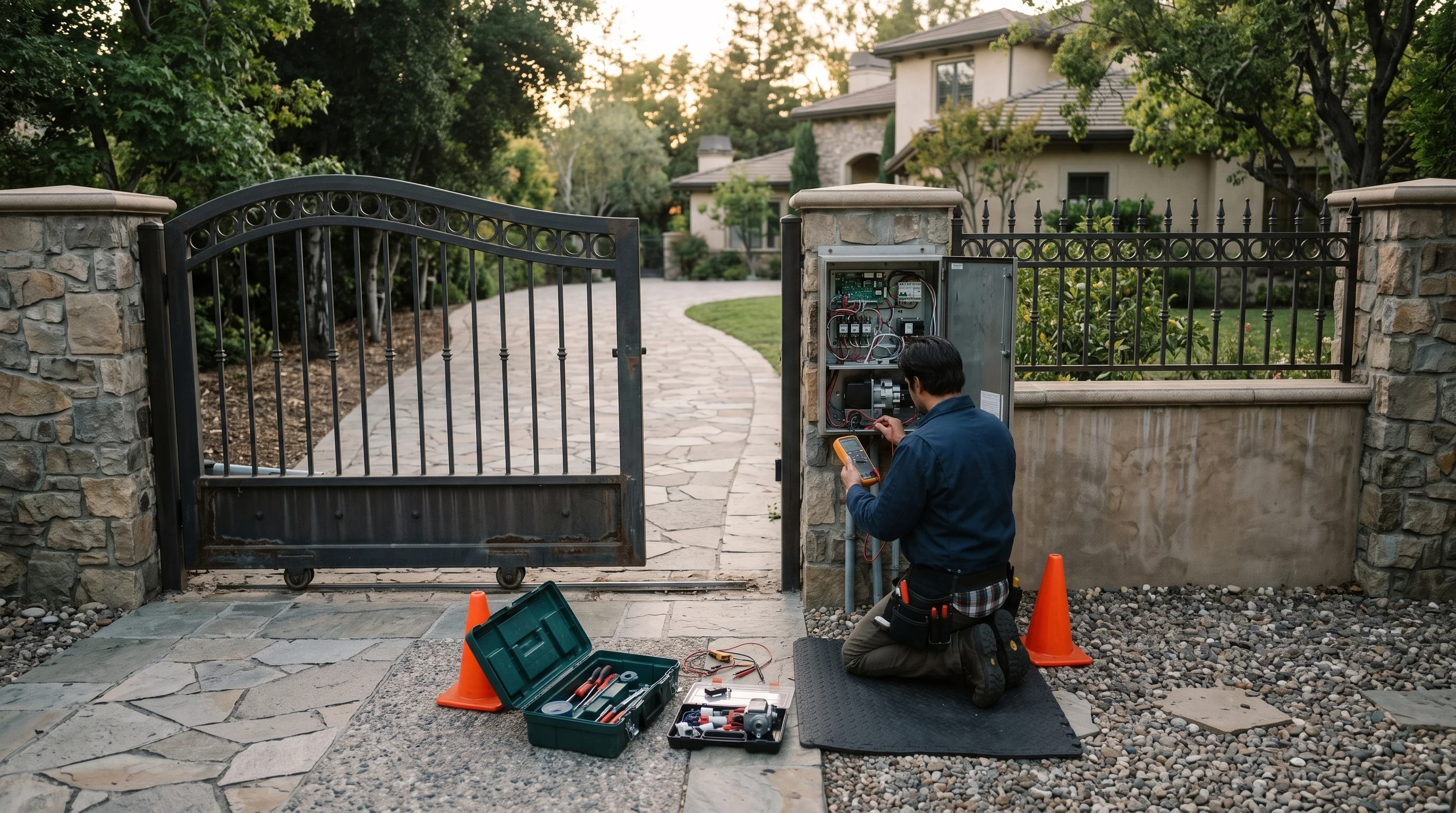
A malfunctioning gate rarely announces itself at a convenient moment. Whether it refuses to open during a morning commute or gets stuck mid-cycle late at night, the disruption is immediate and often stressful. Across the SF Bay Area, property owners depend on automated entry systems to maintain security, manage access, and keep daily life running smoothly. When those systems begin to fail, the need for automatic gate repair becomes more than a preference; it becomes a practical necessity.
Understanding the connection between a faulty gate and daily disruption helps property owners make smarter decisions before minor issues spiral into costly failures.
How Gate Failures Interrupt Daily Routines
Automatic gates are designed for repetition. They open and close dozens of times per week, responding to remote signals, keypads, and vehicle sensors. That level of usage creates wear on motors, hinges, limit switches, and control boards over time.
When any of those components begins to degrade, the effects are felt immediately:
- Morning delays: A gate that hesitates or requires multiple attempts to open can add frustrating minutes to an already tight schedule.
- Security gaps: A gate stuck in the open position removes the primary barrier between the property and unauthorized access.
- Visitor complications: Delivery drivers, guests, and service personnel may be unable to enter or exit, creating logistical headaches.
- Safety risks: A gate that closes unexpectedly or reverses mid-cycle can pose real physical dangers to vehicles and people.
Throughout the SF Bay region, where commute windows are tight and properties often rely on automated systems for both residential and commercial access, even a partial failure can have cascading effects on the day.
Common Signs That Gate Repair Is Overdue
Recognizing the symptoms early is the most effective way to avoid a complete breakdown. Several warning signs suggest that professional attention is needed before the situation worsens.
Unusual noises during operation are among the earliest indicators. Grinding, scraping, or clicking sounds often point to worn gears, misaligned tracks, or debris interference in the mechanical components.
Slow or inconsistent movement signals that the motor or drive system is struggling. A gate that used to open in seconds but now takes much longer is working harder than it should, which accelerates component wear.
Remote or sensor failures can stem from signal interference, damaged receivers, or failing circuit boards. If the gate responds inconsistently to commands, the control system likely needs diagnostic attention.
Physical misalignment is particularly common in SF Bay climates, where temperature swings, coastal moisture, and soil movement can shift gate posts and affect how panels track or swing. A gate that drags along the ground or no longer sits flush in its frame needs structural correction.
Intermittent locking issues where the gate fails to latch or lock reliably represent a direct security concern that should not be delayed.
For property owners in areas like San Jose or Dublin, where high-cycle use is common due to busy household and commuter schedules, these symptoms tend to appear sooner and escalate faster without timely intervention.
Why Waiting Makes Automatic Gate Repair More Expensive
There is a direct relationship between how long a fault is ignored and how much the eventual repair costs. A worn motor bearing, for example, can be replaced at relatively low cost if caught early. Left unaddressed, that same bearing failure can damage the drive shaft, strip the gear assembly, and eventually burn out the motor entirely, turning a minor fix into a full component replacement.
The same logic applies to structural issues. A gate that begins to sag due to a loose hinge puts added strain on the automation hardware every time it cycles. Over weeks or months, that strain transfers to the opener arm, the limit switches, and the control board. What began as a hinge adjustment becomes an electrical repair.
Across the SF Bay Area, the environmental factors compound this pattern. Salt air near coastal communities, heat in inland valleys, and moisture from the marine layer all accelerate the degradation of metal components, seals, and wiring insulation. Routine maintenance and prompt gate repair reduce the long-term impact of these conditions significantly.
When Professional Automatic Gate Repair Is the Right Call
Some gate issues are straightforward enough for a property owner to address, such as clearing debris from a sensor path or replacing a dead remote battery. However, most mechanical, electrical, and structural problems require trained technicians with the proper diagnostic tools and replacement parts.
Professional gate repair is the appropriate response when:
- The motor runs but the gate does not move, suggesting a mechanical disconnect or broken drive component
- The control board displays fault codes or the gate behaves erratically without a clear cause
- The gate has sustained physical damage from a vehicle impact or storm debris
- Wiring shows signs of corrosion, fraying, or rodent damage
- The gate fails to reverse when it detects an obstruction, which is a direct UL 325 safety compliance issue
Attempting to bypass these issues without proper knowledge can void equipment warranties, create liability exposure, and in the case of safety sensor failures, lead to serious injury. The automatic gate repair services available across the SF Bay region are equipped to handle both the diagnostic work and the physical repairs correctly and safely.
The Role of Routine Maintenance in Preventing Disruptions
Reactive repair is always more disruptive than proactive maintenance. A scheduled service visit allows a technician to identify components that are approaching the end of their service life, lubricate moving parts, test safety sensors, and verify that limit switches are calibrated correctly. These visits significantly reduce the likelihood of unexpected failures.
For SF Bay properties with high-traffic gates, such as multi-unit residential buildings, commercial facilities, or homes with frequent deliveries, a maintenance schedule is not optional; it is the most cost-effective strategy for keeping the system reliable. Property owners who want to understand more about the full range of gate and fencing support available can explore the expert automatic gate and fencing services offered throughout the region.
What to Expect from a Gate Repair Visit
When a technician arrives for a gate repair assessment, the process typically begins with a full operational test. The gate is cycled multiple times to observe its behavior under normal conditions. The technician then inspects the mechanical components, checks the control board for fault codes, tests the safety sensors, and evaluates the structural condition of the frame and posts.
Based on those findings, a repair plan is developed. In most cases, common issues such as motor wear, sensor misalignment, or hinge adjustment can be resolved in a single visit. More complex problems involving fabrication or full component replacement may require a follow-up appointment.
Throughout the SF Bay Area, from the North Bay to the South Bay, professional gate technicians carry parts for the most widely used systems, including LiftMaster, FAAC, and Nice, which allows many repairs to be completed on the same day.
A faulty gate is more than an inconvenience. It is a signal that the system requires attention before the disruption becomes a security failure or a safety hazard. Across the SF Bay region, property owners who address gate issues promptly spend less on repairs, experience fewer access disruptions, and maintain the security their properties depend on. Scheduling a professional assessment at the first sign of trouble is always the more practical path forward.